
People are not leaving Atlanta as much as they are recalibrating around it.
That is the real story in 2026.
Atlanta still has the jobs, airport, universities, hospitals, restaurants, sports, culture, and economic pull. But for a growing number of families, professionals, retirees, and remote workers, the day-to-day math has changed.
They want access to Atlanta without living inside the constant pressure of it: more space, better schools, a garage, a yard, quieter streets, a real home office, and a neighborhood where errands feel like a routine instead of a traffic negotiation.
That is why suburbs across North Fulton, Forsyth, Gwinnett, Cherokee, Cobb, and the outer metro are getting so much attention. According to the Atlanta Regional Commission, the 11-county Atlanta region added 64,400 residents from 2024 to 2025, bringing the region to nearly 5.3 million people. The biggest one-year gains came from Fulton, Gwinnett, Cherokee, and Forsyth counties.
That matters. Growth is still happening in the core, but the strongest relocation energy is spreading outward.
And unlike a lot of best-suburb lists, this is not just about where people say they want to live. It is about where people are actually moving, what tradeoffs they are accepting, and what those moves look like on the ground.
Key Takeaways
- Metro Atlanta is still growing, but much of the relocation demand is spreading into suburbs like Johns Creek, Cumming, Suwanee, Duluth, Woodstock, Canton, Alpharetta, Roswell, East Cobb, Smyrna, and Marietta.
- The Atlanta Regional Commission estimates the 11-county region added 64,400 residents from 2024 to 2025, with major growth in Fulton, Gwinnett, Cherokee, and Forsyth counties.
- The biggest reasons people are moving to Atlanta suburbs in 2026 are schools, space, hybrid work, housing value, quieter neighborhoods, and better day-to-day routines.
- The strongest suburbs are not all winning for the same reason: Johns Creek wins on stability, Forsyth wins on growth, Gwinnett wins on diversity and convenience, Cherokee wins on space, and Cobb wins on close-in access.
- Move-day logistics matter more than most relocation articles mention. HOA rules, elevator windows, truck access, traffic timing, school calendars, and GA-400/I-85/I-75 congestion can all affect the move.
Quick Comparison: Atlanta Suburbs Getting the Most Attention in 2026
| Suburb / Area | Best For | Growth Signal | Main Tradeoff | Move-Day Reality |
|---|---|---|---|---|
| Johns Creek | Schools, safety, prestige, family stability | Nationally ranked livability | Expensive, less urban | HOA rules, large homes, high-value items |
| Cumming / Forsyth County | Newer homes, schools, space | Forsyth added 6,700 residents in 2024-2025 | GA-400 dependence | Longer truck routes, full-house moves |
| Suwanee / Duluth / Peachtree Corners | Diversity, food, parks, Gwinnett value | Gwinnett added 15,200 residents | Traffic varies by corridor | Apartments, townhomes, elevator windows |
| Woodstock / Canton | Space, downtown lifestyle, Cherokee growth | Cherokee added 7,100 residents | Longer commute | Large homes, steep drives, subdivision access |
| Alpharetta / Milton | Premium suburban lifestyle | Continued North Fulton demand | High pricing | GA-400 timing, gated communities |
| Roswell | Historic character, river access, restaurants | Downtown investment | Older homes, traffic pockets | Narrow streets, older layouts, access planning |
| East Cobb / Smyrna / Marietta | Close-in suburban compromise | Strong Cobb demand | Varies heavily by school zone | Local moves, downsizing, townhomes |
| Barrow / Walton outer suburbs | Affordability, land, next-wave growth | ARC long-term growth forecast | Distance from Atlanta | Longer-haul planning, fewer backup routes |
The Big Shift: Atlanta Access Without Atlanta Pressure
For years, the simple Atlanta relocation story was “move closer in.” People wanted Midtown, Buckhead, Virginia-Highland, Old Fourth Ward, Decatur, Brookhaven, and Sandy Springs because commute time mattered more than almost anything.
That has not disappeared. But it is no longer the only pattern.
Hybrid work changed the equation. So did home prices, school searches, insurance costs, family formation, and the desire for a calmer routine. A buyer who only drives into the office two or three days a week may accept a longer commute if the tradeoff is a better school district, larger home, lower density, or more predictable family life.
The market is also giving buyers more room to compare. The Atlanta REALTORS Association March 2026 market brief reported 17,723 active listings, up 5.1% year over year, with a 4.0-month supply. Median sale price was $418,000, slightly down year over year.
That does not mean Atlanta is cheap. It means buyers are being more selective. And when people get selective, suburbs with a clear identity win.
What We See on Actual Move Days
The suburbs people choose on paper are not always the suburbs that work smoothly in real life. That is the part most real estate articles miss.
A move to Johns Creek may involve a gated subdivision, long driveway, finished basement, piano, and HOA move-hour restrictions. A move to Cumming may involve a larger truck route, GA-400 delays, and a full house with garage storage, kids’ rooms, outdoor furniture, and oversized pieces. A move to Suwanee or Duluth may involve apartment loading zones, elevator reservations, townhome stairs, and strict move-in windows.
The address matters, but the logistics matter too.
- School calendar timing
- HOA restrictions
- Elevator reservations
- Truck parking
- GA-400, I-75, I-85, and I-285 traffic windows
- New construction traffic
- Closing delays
- Utility transfer timing
- Storage, downsizing, donation, and packing needs
That is why a move from Midtown to Smyrna is not the same kind of job as a move from Alpharetta to Forsyth County, even if both are technically local moves.
Johns Creek: The Quiet Prestige Play
Johns Creek may be the clearest example of the quietly moving trend. It is not loud. It is not trying to be Midtown. It is not built around nightlife. Its appeal is simpler: strong schools, low crime, large homes, well-kept neighborhoods, parks, medical access, and proximity to Alpharetta, Duluth, Suwanee, Roswell, and Cumming.
The national attention helped. Johns Creek was named the No. 1 Best Place to Live in the U.S. for 2025-2026 by U.S. News & World Report, but the ranking mostly confirmed what families had already been acting on. Johns Creek works for people who want suburban stability without feeling disconnected from North Atlanta’s job and lifestyle corridors.
The interesting part is that Johns Creek is also changing. Its Town Center and Medley development are giving the city something it has historically lacked: a more defined center of gravity. Brown Thrasher Movers covered that local shift in its guide to the development changing how Johns Creek moves.
Best for: families prioritizing schools, safety, parks, medical access, and long-term stability.
Tradeoff: Johns Creek is expensive and still more residential than urban. If someone wants nightlife, historic charm, or heavy walkability, Roswell, Alpharetta, Decatur, or Smyrna may feel more natural.
Move-day concern: large homes, gated communities, HOA rules, high-value furniture, pianos, long carries, and summer family-move demand.
Cumming and Forsyth County: Where Families Go for Space
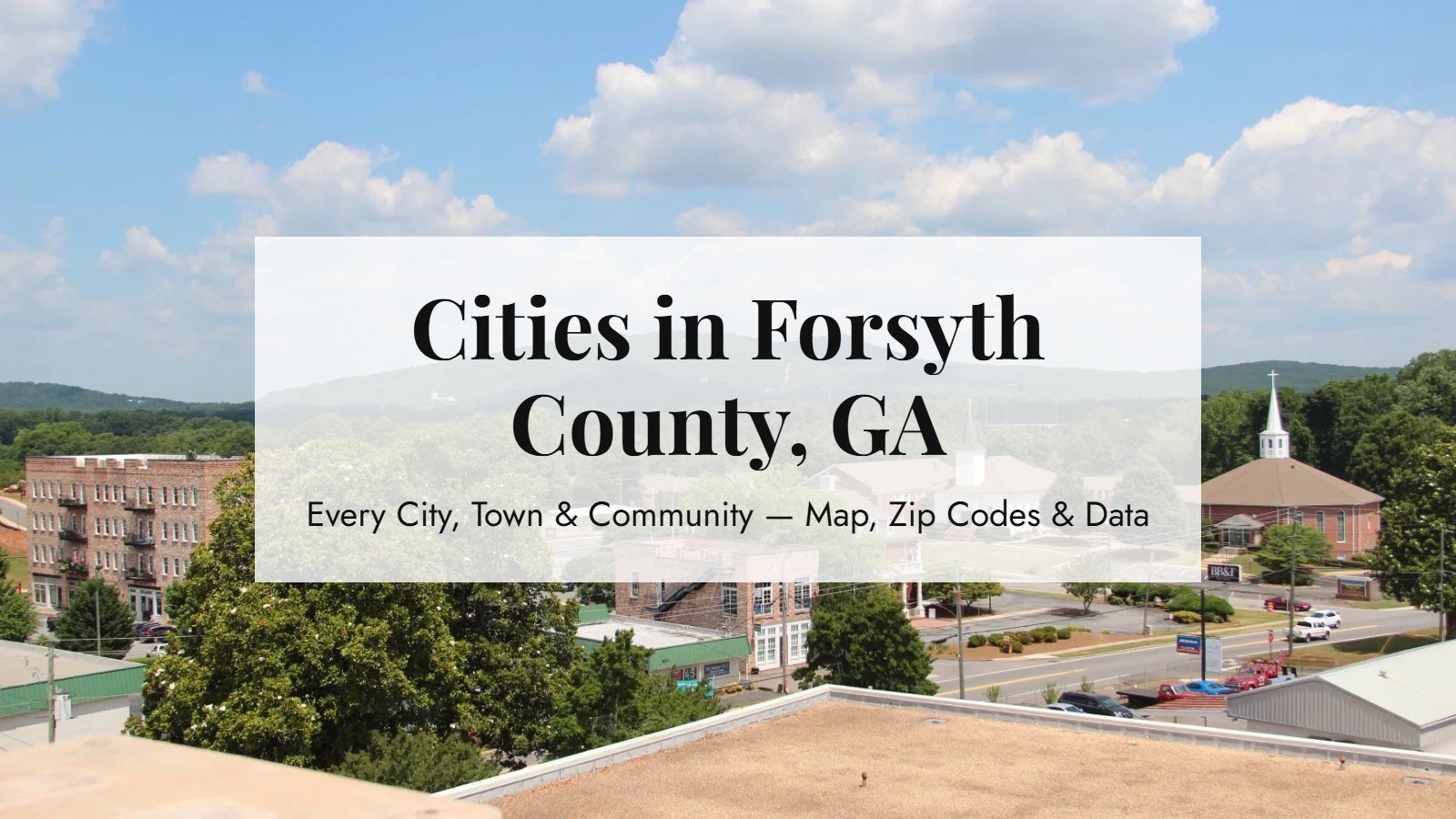
Forsyth County is one of the strongest growth stories in Georgia. ARC estimates Forsyth added 6,700 residents from 2024 to 2025, and its long-term forecasts show Forsyth among the fastest-growing counties in the Atlanta region through 2050.
That is not random growth. It is school-driven, housing-driven, and family-driven. Cumming and Forsyth County appeal to people who want newer homes, larger floor plans, strong schools, Lake Lanier access, and a more suburban or semi-exurban lifestyle while still staying connected to North Fulton through GA-400.
The tradeoff is traffic. GA-400 is the lifeline, but it is also the pressure point. That is why comparisons like Alpharetta vs. Cumming/Forsyth County matter. The right answer depends less on which place is better and more on what kind of life someone is trying to build.
Best for: families wanting more house, newer construction, schools, and access to Lake Lanier or North Georgia.
Tradeoff: commute risk. GA-400 can be manageable at the right times and brutal at the wrong ones.
Move-day concern: full-house moves, longer drive times, larger furniture, storage-heavy garages, and construction near fast-growing corridors.
Suwanee, Duluth, and Peachtree Corners: Gwinnett’s Advantage
Gwinnett County is not just absorbing growth because it is cheaper. It has become a complete suburban economy.
ARC estimates Gwinnett passed 1 million residents and added 15,200 people from 2024 to 2025. That scale gives Gwinnett something many suburbs cannot match: diversity, food, jobs, schools, shopping, parks, and housing variety all in one county.
Suwanee is attractive for parks, schools, and Town Center living. Duluth has one of the strongest food and cultural scenes in the metro. Peachtree Corners offers established neighborhoods, office access, and proximity to the Chattahoochee River corridor.
Best for: families and professionals who value diversity, restaurants, parks, and better relative value than North Fulton.
Tradeoff: Gwinnett traffic is highly corridor-specific. A house that looks close on a map may feel very different during school pickup or evening traffic.
Move-day concern: apartment loading rules, townhome stairs, subdivision parking, and route timing around Peachtree Industrial, Pleasant Hill, I-85, and local school traffic.
Woodstock and Canton: The Cherokee County Pull
Cherokee County’s growth is one of the clearest signs that people are willing to move farther out if the lifestyle tradeoff feels worth it.
Woodstock gives buyers a walkable downtown, trails, restaurants, and a strong community feel. Canton offers more space, newer subdivisions, and access to a more relaxed North Georgia lifestyle. Both attract people who still want metro Atlanta access but do not want the density or pricing of closer-in suburbs.
Many people moving to Cherokee are not chasing hype. They are trying to get a larger home, a little more breathing room, and a daily routine that feels less compressed. Cherokee added 7,100 residents from 2024 to 2025, matching Forsyth’s 2.4% annual growth rate, according to ARC.
Best for: buyers who want space, trail access, a stronger small-city feel, or a more relaxed pace northwest of Atlanta.
Tradeoff: commute distance. Woodstock is easier for many metro routines than Canton, but both require honest commute testing.
Move-day concern: larger homes, steep driveways, narrow subdivision streets, heavy garage contents, and longer truck routes.
Alpharetta, Milton, and Roswell: Still Expensive, Still Worth Watching
Alpharetta and Milton are not hidden gems. They are established premium markets. But they still belong in this conversation because people continue moving there for a reason.
Alpharetta has Avalon, Downtown Alpharetta, strong schools, corporate offices, healthcare access, restaurants, parks, and GA-400 connectivity. Milton offers more privacy, larger lots, and a lower-density feel. Roswell has historic character, Canton Street, river access, older neighborhoods, and a real sense of place.
The challenge for all three is movement. GA-400 construction, local road congestion, and school-year timing all affect relocation planning. Brown Thrasher Movers covered that larger infrastructure issue in its article on how the GA-400 expansion is changing moving in Atlanta.
Best for: buyers who want premium amenities, schools, restaurants, North Fulton access, and strong resale appeal.
Tradeoff: price. These are not bargain suburbs. Buyers are paying for convenience, schools, lifestyle, and location.
Move-day concern: GA-400 timing, gated communities, high-value items, older Roswell layouts, and tight downtown-area access.
East Cobb, Smyrna, and Marietta: The Close-In Compromise
Not everyone wants to move farther north. East Cobb, Smyrna, and Marietta continue to attract people who want suburban living without fully disconnecting from Atlanta.
East Cobb is heavily school-driven. Smyrna appeals to people who want proximity to The Battery, I-285, I-75, and Atlanta. Marietta gives buyers a wide range of choices, from historic homes to established subdivisions to more affordable pockets.
These areas are especially appealing for local moves. Someone may be leaving a Buckhead apartment for a Smyrna townhome, moving from Sandy Springs to East Cobb for schools, or downsizing from a larger Cobb home into something more manageable near Marietta Square.
Best for: people who want suburban space but still need strong access to Atlanta, Cumberland, Buckhead, Sandy Springs, or I-75/I-285.
Tradeoff: school zones, traffic, and walkability vary dramatically by neighborhood.
Move-day concern: townhome stairs, older home layouts, tight driveways, local traffic, and downsizing moves.
The Next Wave: Barrow, Walton, and Outer Suburbs
The outer counties are also worth watching. ARC forecasts some of the fastest long-term growth through 2050 in places like Forsyth, Barrow, Paulding, Cherokee, Walton, and Coweta, according to its long-term regional forecasts.
That does not mean every buyer should go that far out. It means affordability pressure and lifestyle preferences are pushing the edge of the metro wider.
For people who work remotely, commute irregularly, own a business, or want more land, places like Winder, Auburn, Monroe, and nearby communities may become more attractive. The tradeoff is distance. A lower home price does not always feel like a win if the commute eats your week.
Best for: remote workers, land buyers, affordability seekers, and people who do not need a daily Atlanta commute.
Tradeoff: distance from core Atlanta job centers, airport access, nightlife, and some healthcare or specialty services.
Move-day concern: longer travel windows, fewer route options, and more importance on accurate inventory and truck planning.
Best Atlanta Suburbs by Lifestyle in 2026
Best for schools and stability: Johns Creek, East Cobb, Alpharetta, Milton, Cumming/Forsyth County.
Best for more space: Canton, Cumming, Milton, outer Cherokee, Barrow, Walton.
Best for close-in convenience: Smyrna, East Cobb, Marietta, Roswell, Sandy Springs.
Best for food and diversity: Duluth, Suwanee, Peachtree Corners, parts of Gwinnett.
Best for walkable suburban feel: Woodstock, Roswell, Alpharetta, Smyrna, Marietta.
Best for downsizing: Roswell, Marietta, Peachtree Corners, Johns Creek townhome pockets, Alpharetta mixed-use areas.
Best for hybrid workers: Cumming, Woodstock, Canton, Suwanee, Milton, outer Cobb, Barrow, Walton.
Best for long-term growth: Forsyth, Cherokee, Gwinnett, Barrow, Walton, Coweta.
What This Means If You Are Planning a Move
The best Atlanta suburb in 2026 depends on what you are optimizing for.
If you want prestige, schools, and stability, Johns Creek is hard to ignore. If you want growth, newer homes, and family infrastructure, Cumming and Forsyth County are major contenders. If you want diversity, restaurants, and value, Gwinnett deserves a serious look. If you want space and a different pace, Woodstock and Canton are pulling people northwest. If you want close-in convenience, East Cobb, Smyrna, Marietta, Roswell, and Alpharetta still make sense.
Before choosing, drive the commute at the actual time you would drive it. Visit the grocery store after work. Check the school route in the morning. Look up HOA rules. Ask about truck access, elevator reservations, parking restrictions, and closing-date flexibility.
A good move is not just about where the house is. It is about whether the whole routine works.
Brown Thrasher Movers serves homeowners, renters, families, seniors, and businesses across the metro Atlanta suburbs. You can check the company’s full areas served or review its moving services if you are planning a local, apartment, long-distance, packing, senior, or white-glove move.
Sources Used
This article was built using public market data, local planning sources, real estate market reporting, and Brown Thrasher Movers’ local moving experience across metro Atlanta.
- Atlanta Regional Commission Population Estimates — metro Atlanta population growth, county-level gains, and regional estimates.
- Atlanta Regional Commission 2050 Forecasts — long-term growth outlook for Forsyth, Cherokee, Barrow, Walton, Coweta, and other fast-growing counties.
- Atlanta REALTORS Association Market Brief — March 2026 housing inventory, supply, and median sale price data.
- FRED / Realtor.com Atlanta Metro Listing Price Data — Atlanta-Sandy Springs-Roswell metro median listing price data.
- City of Johns Creek Announcement — Johns Creek’s 2025-2026 national livability ranking.
FAQ: Moving to Atlanta Suburbs in 2026
What Atlanta suburbs are people moving to in 2026?
Some of the strongest Atlanta suburbs in 2026 include Johns Creek, Alpharetta, Milton, Roswell, Cumming, Suwanee, Duluth, Peachtree Corners, Woodstock, Canton, East Cobb, Smyrna, and Marietta. Outer markets like Barrow, Walton, and Coweta are also becoming more important as affordability pressure pushes some buyers farther from the core.
Why are families moving from Atlanta to the suburbs?
Families are usually looking for more space, strong schools, quieter neighborhoods, parks, youth sports, lower density, and a more predictable daily routine. Many still want Atlanta access, but they do not necessarily want to live in the city itself.
Is Forsyth County still growing?
Yes. Forsyth County remains one of the strongest growth markets in metro Atlanta. ARC estimates Forsyth added 6,700 residents from 2024 to 2025, and long-term forecasts show Forsyth among the fastest-growing counties in the Atlanta region through 2050.
Is Johns Creek worth moving to in 2026?
Johns Creek is worth serious consideration for families and professionals who prioritize schools, safety, parks, medical access, and a polished suburban lifestyle. The tradeoff is cost. It is one of the more expensive suburban markets in North Atlanta, and it is quieter than places like Roswell, Alpharetta, or Smyrna.
What is the most affordable Atlanta suburb to watch?
Affordability changes quickly, but buyers looking for more value often compare parts of Gwinnett, Cherokee, Barrow, Walton, Paulding, and Henry counties. The key is not just home price. Commute time, school needs, insurance, property taxes, and daily convenience all affect the real cost of living.
Which Atlanta suburbs are best for remote or hybrid workers?
Remote and hybrid workers often have more flexibility to consider Cumming, Woodstock, Canton, Suwanee, Milton, outer Cobb, Barrow, Walton, and Coweta. If someone only commutes two or three days per week, a farther-out suburb may make sense. If they commute daily, closer-in suburbs like Smyrna, East Cobb, Roswell, Sandy Springs, or Alpharetta may work better.
Are Atlanta suburbs still cheaper than living in the city?
Sometimes, but not always. Some suburbs, especially Johns Creek, Alpharetta, Milton, East Cobb, and parts of Roswell, can be just as expensive as intown neighborhoods. The difference is often what the buyer gets for the money: more square footage, stronger schools, newer homes, a yard, or a quieter neighborhood.
What should I check before moving to an Atlanta suburb?
Check the commute at real commute times, school assignments by exact address, HOA rules, property taxes, traffic patterns, grocery access, healthcare access, and move-day logistics. If moving into an apartment, condo, townhome, or gated community, confirm elevator reservations, loading zones, parking rules, and allowed move hours before move day.
The Bottom Line
The suburbs winning in 2026 are not winning by accident. They are giving people something specific: access to Atlanta, but with more control over daily life.
That is the real reason people are moving quietly. Not because Atlanta is over. Not because everyone wants the same suburb. But because buyers and renters are becoming more intentional.
They are choosing the school district, commute pattern, grocery run, park system, home office, town center, and neighborhood rhythm that actually fit their lives.
In 2026, the Atlanta relocation story is not just about moving out. It is about moving smarter.