Last updated: October 17, 2026. This guide to moving to Georgia Tech or Clark Atlanta covers confirmed 2026 campus developments and early planning information for the 2027 academic year. Check each university’s housing website for new move-in dates, assignments and access rules. We’ll update this guide when the 2027 details are released.
If you’ve driven down Northside Drive lately, you’ve seen the cranes. In August 2026, Georgia Tech opened the Bud and Val Peterson Residence Hall, its first new traditional residence hall in more than 50 years. It sits right on the western edge of campus. A few blocks away, new apartments are rising along the Northside corridor. Farther south, Clark Atlanta University and its Atlanta University Center neighbors are building new student facilities and housing too.
All that growth is good news for students. It also changes how moving day works. Road closures move around. Parking that existed last year is now a building. And thousands of students arrive in the same few days.
This guide is for students and parents moving to Georgia Tech or Clark Atlanta in 2027. It covers what’s being built, how each school’s move-in works, what off-campus apartment buildings require, and what local movers cost. It also explains when hiring apartment movers in Atlanta saves you time and when it doesn’t.
Already know you’d like a hand? See our School & University Relocation services for students, families and faculty.
At a glance: moving to Georgia Tech or Clark Atlanta
| Georgia Tech | Clark Atlanta University | |
|---|---|---|
| Newest housing | Bud and Val Peterson Residence Hall, opened fall 2026, about 860 beds | New 400-student residence hall announced; opening date not yet published |
| Who must live on campus | Not required, but Georgia Tech encourages first-years to live on campus | Students with fewer than 58 earned credit hours, subject to availability |
| Furniture provided | Yes, in all halls except Tenth and Home family housing | Check with Residence Life for your hall |
| Move-in appointment | Required, booked through My Housing | Instructions sent by Residence Life |
| Key moving-day limit | 7’6″ vehicle height limit at centralized check-in | Check your hall’s unloading instructions |
| 2026 fall move-in (for reference) | Centralized Aug. 15–16; decentralized Aug. 18–22 | Set by CAU each year |
What’s being built around Georgia Tech
Georgia Tech is in the middle of its biggest building run in decades. Here are the projects that matter most for anyone moving in or out.

Bud and Val Peterson Residence Hall (formerly the Curran Street Residence Hall)
This is the building you’ve been watching go up along Northside Drive between Eighth and Ninth streets. It began as the “Curran Street Residence Hall” project and was renamed for Georgia Tech’s 11th president and first lady. The ribbon-cutting was held on August 13, 2026.
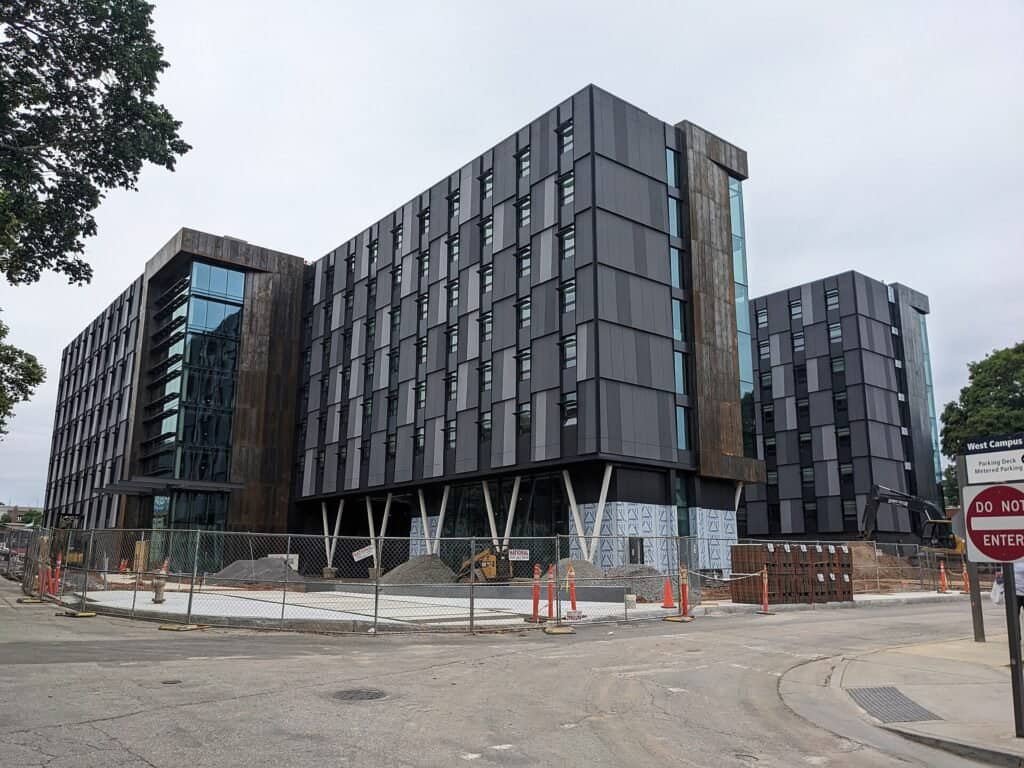
- Address: 920 Curran St NW, Atlanta, GA 30332, on West Campus
- Size: about 191,000 square feet in two connected buildings, with about 860 beds for first-year students (Georgia Tech’s announcement says 862; its housing listing says 860)
- Rooms: traditional doubles with shared bathrooms on each floor
- Amenities: community lounges, a kitchen in each wing, an esports lounge, a fitness room, and a 24/7 cashierless market
- 2026–27 rate: $3,953 per semester
One moving tip that’s easy to miss: the communal kitchens don’t come with cookware or utensils, so pack your own pots, pans and plates.
With Peterson open, Georgia Tech now has more than 9,600 beds across nearly 50 residence halls. That also means more students moving in on the same weekend.
Here’s Georgia Tech’s own look at the new hall when it opened:
View this post on Instagram
Smith and Howell residence hall renovations
Georgia Tech is renovating the historic Smith and Howell halls on East Campus. The work updates building systems, adds a new connector building between the two halls, and improves accessibility. In summer 2026, it closed Techwood Drive between Bobby Dodd Way and North Avenue for utility work. Expect renovation-related closures like this to keep shifting through 2027. Students moved out of renovated halls are one reason the new hall was built.
PATH Westside Connector
The City of Atlanta is building a multi-use path linking the Westside BeltLine Connector to Georgia Tech’s main campus. The city’s projected construction dates run from November 2026 to February 2028, and both the dates and the traffic impacts can change. If you’re moving into West Campus or an apartment west of Northside Drive, plan for lane changes during that window.
The Northside Drive corridor
Northside Drive is the spine connecting Georgia Tech, the Mercedes-Benz Stadium area, the Atlanta University Center and West End. It’s changing fast. Just southwest of Bobby Dodd Stadium, Legacy at Herndon Square opened 201 mixed-income apartments in 2026, and a 178-unit third phase is due in 2027. Next door, the Science Square district is adding research space and apartments. These aren’t student dorms, but they bring more trucks, more residents and more construction to the same stretch of road.
The Midtown student tower boom
Off campus, the growth is just as big. Rambler Atlanta, a 19-story, 798-bed student tower on Peachtree Street, opened in 2025, less than a quarter-mile from Tech Square. Midtown Alliance counted roughly 8,500 college students among Midtown’s 28,000 residents. Many of them change apartments every August.
What the construction means if you’re moving to Georgia Tech
New buildings make campus better. On move-in weekend, though, they mainly add complications. Plan around these five.
- Routes change every year. Closures for utility work, sidewalks and new paths shift from summer to summer. Georgia Tech publishes a move-in traffic plan each August. In recent years, cars entered westbound on North Avenue, turned onto Tech Parkway, and checked in at the Campus Recreation Center parking deck. Check the current year’s map before you leave home.
- Rental trucks may not fit. Georgia Tech’s centralized check-in location has a maximum vehicle height of 7 feet 6 inches. Most rental box trucks are taller than that. The limit applies to the check-in location, not to every loading area on campus. If you’re hauling furniture in a truck, plan a separate drop-off route or let a moving crew handle the large items.
- You can’t leave the car. At unloading zones, Georgia Tech asks families to stay with the vehicle, load items into a bin, then move the car to short-term parking right away.
- The surrounding streets are busy too. Rambler, Herndon Square and other new buildings run their own move-ins in August. Expect delays on Northside Drive, Techwood Drive, 10th Street and Centennial Olympic Park Drive.
- Lots become buildings. Peterson Hall was built on a former parking lot and landscape yard. Don’t count on parking that used to be there.
Before you arrive with a truck or a moving crew
Check these five things the week before:
- Your school’s current move-in map and traffic plan. Start with Georgia Tech’s new-student move-in page or the emails from CAU Housing and Residence Life.
- Vehicle height. At Georgia Tech, the centralized check-in location allows vehicles up to 7’6″. Ask where taller trucks should go.
- Whether outside movers are allowed. Ask Residence Life whether a hired crew may work at your hall’s unloading zone, and when.
- Unloading time limits. Most zones allow short stops only, so plan when the car or truck will move to parking.
- A contact on the day. Save the number for your hall’s area office or Residence Life desk.
Moving to Georgia Tech: move-in, step by step
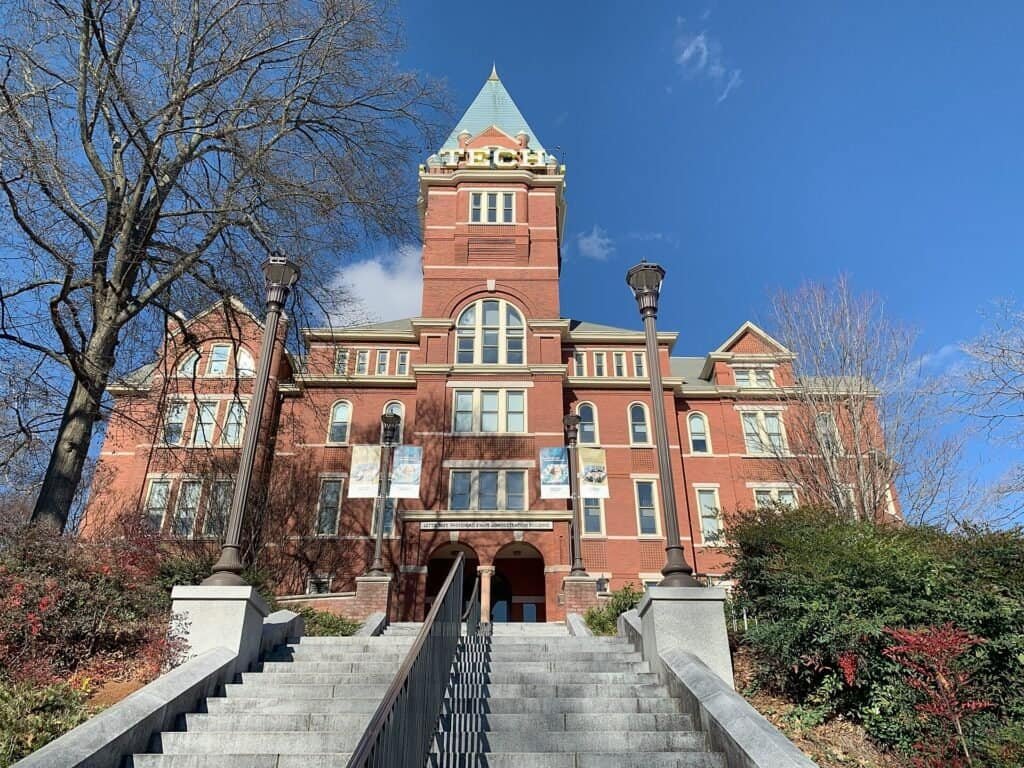
- Apply for housing and get your assignment through My Housing. Check your hall, room type and roommate there.
- Book your move-in appointment. Georgia Tech sends time-tickets by email, and every resident must choose a slot before arriving. For reference, 2026 fall centralized move-in for new students ran August 15–16, and decentralized move-in for returning students ran August 18–22. Watch for the 2027 dates in spring.
- Pack light. All Georgia Tech halls come furnished except Tenth and Home family housing, so Housing asks students not to bring furniture. A mini-fridge, storage bins, bedding, a desk lamp and kitchen basics (for Peterson Hall) cover most needs.
- Ship what you can. Mail and packages go through the central Georgia Tech Post Office. You’ll get your mailing address from Housing.
- Complete self check-in about 30 minutes before your appointment, then follow volunteers to your unloading zone. Bins are available every day of move-in.
- Fill out your room condition report after you move in. It protects you at move-out.
- Plan move-out early. Spring move-out comes right after finals, often with a short window to vacate. Book storage or movers well ahead, because May dates fill up fast.
Move-in weekend fills campus fast. Here’s what it looked like when first-year Yellow Jackets arrived in August 2026:
View this post on Instagram
Moving to Georgia Tech from out of state? Our long-distance moving crews can bring larger loads into Atlanta, and our School & University Relocation team handles the campus side.
Moving to Clark Atlanta University
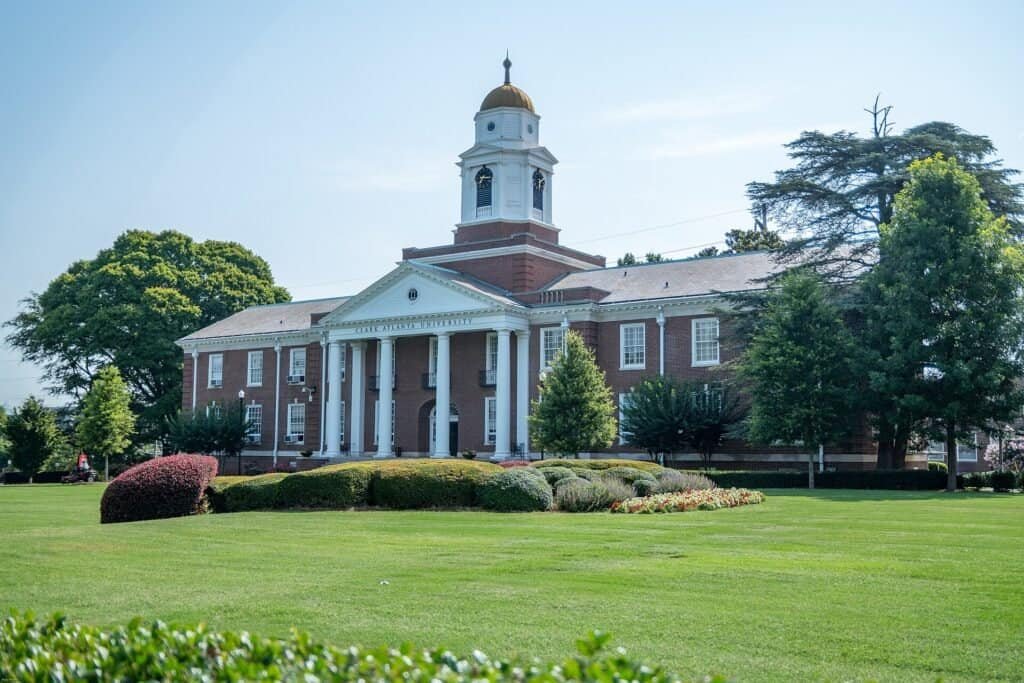
Clark Atlanta University (CAU) is a private, historically Black university in southwest Atlanta. It’s part of the Atlanta University Center Consortium, the nation’s largest concentration of historically Black colleges and universities. Its neighbors include Morehouse College, Spelman College and Morehouse School of Medicine. The main campus address is 223 James P. Brawley Drive SW, Atlanta, GA 30314.
Who has to live on campus
CAU requires students with fewer than 58 earned credit hours to live on campus, subject to availability. Housing is assigned first come, first served, so apply early. Exemptions can be granted with documentation, including for students whose families live in metro Atlanta. Upperclassmen and graduate students aren’t guaranteed campus housing, and CAU points them to off-campus resources such as its partnership with College Pads. All undergraduates also need a university meal plan.
What’s changing on campus
In 2023, CAU’s board approved three new buildings at once:
- A new first-year residence hall for 400 students, the first CAU has built and owned since Brawley Hall went up for the 1996 Olympics. CAU hasn’t published an opening date yet.
- A second dining hall at the Bumstead/Ware site.
- A $12 million, 48,000-square-foot Student Success Center, which broke ground in 2025 and was scheduled to finish by fall 2026.
Clark Atlanta President George T. French Jr. laid out the university’s progress, including its building plans, at this year’s State of the University address:
View this post on Instagram
The AUC housing pipeline
Across the AUC, more beds are coming. On October 15, 2026, Morehouse and Spelman broke ground on The Den at 850 West, a $147 million student community with 793 beds in 305 apartments on West End Avenue. Students are expected to move in by fall 2028, with rents averaging about $1,200 per bed. The building is for Morehouse and Spelman students, not CAU students. Still, it adds to a busier AUC housing market, and more students across the consortium will be moving between dorms and apartments each year.
Clark Atlanta move-in tips
- Follow the emails. CAU’s Office of Housing and Residence Life sends hall-specific move-in instructions. Read them closely for unloading locations and times.
- Coordinate with your roommate so you don’t both bring a fridge, a rug and a TV.
- Expect AUC-wide traffic. Several AUC schools move students in during the same weeks, so the streets around James P. Brawley Drive and Joseph E. Lowery Boulevard get crowded.
- Know who’s already working on campus. CAU lists Storage Scholars as its preferred moving, storage and shipping partner. A local Atlanta crew like ours is a good fit for off-campus apartments, family-arranged moves and anything the partner program doesn’t cover.
If you’d rather skip the lifting, our labor-only moving help team can unload your car or truck and carry everything to your room. Confirm with Residence Life first that outside movers are allowed at your hall.
Moving off campus: Midtown, West Midtown and beyond
After the first year, many Georgia Tech and Clark Atlanta students move into apartments. Off-campus moves are where students most often need apartment movers in Atlanta. Apartments are often unfurnished, and high-rise buildings have strict rules.

What Atlanta apartment buildings usually require
- A move-in reservation. Most Midtown and downtown towers book the freight elevator and loading dock in time blocks. Book yours as soon as you sign the lease.
- A certificate of insurance (COI) from your mover. Many buildings won’t let a crew in without one. Ask the leasing office for its COI requirements and send them to your mover early.
- Elevator padding and floor protection. Good crews bring their own.
- Truck size limits. Some parking decks and loading docks can’t fit a full-size truck. Ask the clearance height when you book.
Our Midtown movers can provide COI documentation once you send the building’s certificate-holder details. They’ll plan around your freight-elevator and loading-dock reservations, which you book with your building.
Neighborhoods near Georgia Tech and Clark Atlanta
| Area | Near | What moving there is like |
|---|---|---|
| Midtown | Georgia Tech (east side, Tech Square) | High-rise student towers; reservations and COIs are standard |
| West Midtown | Georgia Tech (west side, Peterson Hall) | Mix of mid-rise apartments and lofts; active construction near Northside Drive |
| Home Park | Georgia Tech (north of 10th Street) | Older houses and small buildings; narrow streets and stairs, little truck parking |
| Atlantic Station | Georgia Tech (northwest) | Large apartment buildings with structured parking and loading areas |
| Downtown | Georgia Tech and Georgia State | Student towers near Centennial Olympic Park; busy streets on event days |
| West End / AUC | Clark Atlanta, Morehouse, Spelman | Growing apartment supply; 850 West End Ave opens fall 2028 |
Downtown vs Midtown Atlanta for students: Midtown puts you closer to Tech Square, Piedmont Park and the Midtown MARTA stations. Downtown can cost a little less and sits closer to Georgia State and the stadium district. It also gets heavy event traffic that can block a moving truck on game and concert days. Either way, check your building’s move-in rules before you book a crew.
Graduate students, faculty and families often live farther from campus, in Buckhead or Smyrna, and commute in. See all the areas we serve across metro Atlanta.
How much do local movers cost in Atlanta?
Most local movers in Atlanta charge by the hour. In Georgia, movers’ charges for moves within the state are capped by the Department of Public Safety’s Maximum Rate Tariff No. 7, in effect since January 13, 2026. The total cost of movers for a local move depends on how long the job takes, and that depends on:
- How much you’re moving. A dorm room isn’t a two-bedroom apartment.
- Stairs, elevators and walking distance. A long hallway from the loading dock adds time.
- Building rules. Waiting for a reserved elevator still counts as time.
- Packing. Boxes packed before the crew arrives save money.
- Traffic and construction. The drive between campus and your apartment counts, and so do detours.
Moving within the city between school years? Our local moving service covers moves across intown Atlanta.
Movers cost per hour: what to expect
Brown Thrasher Movers charges only for time worked, with a flat-rate deposit to lock in your date. Every move is different, so we quote each job individually. To give you a starting point, here are realistic ranges based on actual moves in the Atlanta area.
Typical local moves within metro Atlanta:
| Home size | Typical price range |
|---|---|
| Studio / 1-bedroom | $1,000–$1,800 |
| 2-bedroom | $2,000–$3,000 |
| 3-bedroom | $3,000–$5,000 |
| 4+ bedroom | $5,000–$8,000+ |
For longer moves, moves within Georgia typically run $1,900–$4,700+, and interstate moves $5,000–$10,000+. A dorm unload with labor-only help is usually smaller than any of these and is quoted per job.
These ranges are estimates. The final bill depends on hours worked, access and building rules.
For a personalized number, try our Atlanta moving estimate calculator.
How to keep your move affordable
Affordable movers in Atlanta are easiest to find in June, July and mid-semester. The weeks around August move-in and May move-out are peak season. To keep the bill down:
- Book early for August and May dates.
- Pack everything and label boxes by room before the crew arrives.
- Use free reusable moving boxes instead of buying cardboard.
- Hire labor-only help if you already have a vehicle.
- Pick a weekday if your lease allows it.
DIY, movers, labor-only or shipping? Compare your options
| Option | Best for | Watch out for |
|---|---|---|
| Family car, DIY | First-year dorm moves with few items | Hours in move-in lines; heavy lifting in heat |
| Rental truck, DIY | Apartment moves with furniture | Georgia Tech’s 7’6″ check-in limit; parking and loading-dock rules |
| Labor-only movers | You have a vehicle and need muscle | You still drive; book a time window that matches your appointment |
| Full-service movers | Apartments, furniture, out-of-town families | Book early for August; send the COI to your building |
| Shipping or storage company | Students flying in from far away | Delivery windows and per-box fees |
Moving help in Atlanta: when labor-only makes sense
Labor-only moving help works well for students. If your family drives in with a loaded SUV or a small trailer, a crew can meet you on move-in day and carry everything in. Ask your school first whether outside moving crews may work in its unloading zones. It’s also the easiest way to get moving labor in Atlanta for a loft bed, a couch or a desk going up three flights in Home Park.
See how it works on our labor-only moving help page.
Storage between semesters
Summer internships, study abroad and lease gaps leave a lot of students with stuff and nowhere to put it. If your lease ends May 31 and the next one starts August 1, you’ll need storage in between.
- Moving companies with temporary storage solutions in Atlanta can pick up from your dorm or apartment, hold everything, and deliver to your new address in the fall. Brown Thrasher doesn’t offer storage right now, but we can handle the move out in May and the move in come August.
- Self-storage near campus works if you have a vehicle. For electronics, instruments and wood furniture in Atlanta’s summer heat, look for the best climate-controlled storage you can afford, even if it’s not the cheapest.
- Student storage companies pick up by the box, which works for small loads.
Whatever you choose, book before finals week. Move-out deadlines come fast after the last exam.
Year two and beyond: dorm-to-apartment and apartment-to-apartment moves
The first move is usually the easy one. By sophomore or junior year, you’re likely moving out of a furnished dorm into an empty apartment, or between apartments when a lease ends. Many Atlanta leases end in late July and start in August, so dates often overlap.
- Dorm to apartment: you’ll suddenly need a bed, a desk and a couch. Schedule furniture deliveries for after your move, or have movers pick items up from family or a store on the way.
- Apartment to apartment: apartment-to-apartment movers can move you out in the morning and in that afternoon, as long as both buildings have reserved elevator times. Line up the two reservations first, then book the crew.
- Roommate moves: split the bill by putting each person’s boxes in a different color or label. It keeps the unload fast and the invoice easy to divide.
Our apartment moving crews and packing and unpacking service are built for exactly these tight August turnarounds.
How to choose a mover for a student move
The best moving companies for apartment moving in Atlanta check out on paper before they ever show up. Ask these questions.
- Are you licensed? Georgia requires moving companies working within the state to hold a Certificate of Public Convenience and Necessity from the Georgia Department of Public Safety, and you can check any mover in the DPS household-goods directory. A USDOT number alone doesn’t prove that authorization. Brown Thrasher Movers is a licensed Georgia mover and holds USDOT 4528173.
- What insurance coverage do you carry? This is the real answer to “what professional movers have insurance coverage.” Ask for liability coverage, valuation options for your belongings, and a COI your building will accept.
- What do your reviews say about student and dorm moves? Read dorm-mover reviews for punctuality and care on tight move-in windows, not just price.
- How do you charge? Hourly with a written estimate is standard. Ask what happens if a building delays the elevator.
- Can you handle last-minute changes? Last-minute movers in Atlanta are hard to find in August. Ask how far ahead to book and whether there’s a waitlist.
Printable checklist for moving to Georgia Tech or Clark Atlanta
8–12 weeks before
- Confirm your housing assignment and roommate.
- Book your move-in appointment as soon as time-tickets or instructions arrive.
- For off-campus moves, ask the building for its reservation and COI rules.
- Get moving quotes and book a crew for peak dates.
4–6 weeks before
- Coordinate shared items with roommates.
- Order bedding, storage bins and (for Peterson Hall) basic cookware.
- Pick up free reusable moving boxes and start packing off-season clothes.
- Check the latest campus construction and road-closure updates.
1 week before
- Pack and label every box with your name, hall and room number.
- Confirm your mover’s arrival time and send them your move-in appointment window.
- Check your vehicle’s height if you’re driving a truck to Georgia Tech check-in.
- Download the school’s move-in map.
Moving day
- Arrive for check-in at your appointment time.
- Stay with the vehicle while unloading, then move it to short-term parking.
- Photograph your room and complete the room condition report.
- Keep a “first night” bag with chargers, toiletries, medication and a towel.
Frequently asked questions
Can I bring a U-Haul when moving to Georgia Tech? You can drive one to campus, but Georgia Tech’s centralized check-in location has a 7’6″ height limit, which most rental box trucks exceed. Check the current move-in map for alternate routes, or have movers bring large items separately.
What is the new residence hall on Northside Drive? It’s the Bud and Val Peterson Residence Hall, formerly called the Curran Street Residence Hall. It opened in fall 2026 at 920 Curran St NW and houses about 860 first-year students.
Do I need to bring furniture to a Georgia Tech dorm? No. Georgia Tech halls are furnished, except Tenth and Home family housing, and Housing asks students not to bring furniture.
Do Clark Atlanta students have to live on campus? Students with fewer than 58 earned credit hours must live on campus, subject to availability. Exemptions are available with documentation, including for students from metro Atlanta.
How much do movers cost per hour in Atlanta? Most local movers charge an hourly rate per crew and truck. Every move is different, so Brown Thrasher quotes each job individually. Total cost depends on how much you’re moving, stairs and elevators, and traffic.
How much does local moving cost for a student? A dorm unload with labor-only help often takes a couple of hours. A one-bedroom apartment usually takes longer. Typical Atlanta ranges are $1,000–$1,800 for a studio or one-bedroom and $2,000–$3,000 for a two-bedroom. Use our estimate calculator for a personalized number.
When should I book movers for August move-in? As soon as you have your move-in date. Mid-August is the busiest stretch of the year for student moves in Atlanta.
Ready for move-in day?
Georgia Tech’s new halls and Clark Atlanta’s growing campus make 2027 an exciting year to move to Atlanta. The construction and crowds mean a little planning goes a long way. If you’re moving to Georgia Tech or Clark Atlanta, Brown Thrasher Movers is a licensed local crew that knows Midtown, West Midtown and the AUC. We offer upfront quotes, labor-only help and free reusable boxes.
See our School & University Relocation services or get a free quote. You can also call (706) 908-4815.