The closest cities to Atlanta, GA are Decatur (6 miles), Hapeville (7), East Point (8), College Park (9), and Brookhaven (10). The largest cities near Atlanta are Sandy Springs and South Fulton (~110,000 residents each), Roswell (~93,000), Johns Creek (~82,000), and Mableton (~78,000) — and if that last name isn’t on the list you read elsewhere, that’s because Mableton only became a city in 2023, and most guides haven’t caught up. Metro Atlanta is home to roughly 6.5 million people across 6,000+ square miles, making it the sixth-largest metro area in the United States.
But if you’re relocating here, a list of city names doesn’t answer your real question — which is usually some version of “how does Atlanta actually work, and where should I live?” Atlanta is the largest city in Georgia and the state capital, sitting in the northern part of the state — but the surrounding cities of Atlanta are where most of the metro’s 6.5 million people actually live. This guide compares every notable one by distance, commute, MARTA access, and home prices, organized by direction — plus the ITP/OTP explanation every newcomer needs and nobody gives them.
Metro Atlanta at a Glance
Thirty seconds of orientation before the details. The metro is usually discussed by direction from Downtown:
- North (Fulton/Forsyth) → Sandy Springs, Roswell, Alpharetta, Johns Creek, Milton, Cumming — the affluent tech-and-schools corridor along GA-400; use our guide to every city and community in Forsyth County if you are narrowing in on Cumming or the Forsyth side of the corridor
- Northwest (Cobb/Cherokee) → Smyrna, Marietta, Mableton, East Cobb, Kennesaw, Acworth, Woodstock, Canton — value, space, and the I-75/I-575 corridor
- Northeast (DeKalb/Gwinnett) → Brookhaven, Chamblee, Doraville, Dunwoody, Peachtree Corners, Duluth, Suwanee, Lawrenceville — diverse, fast-growing, I-85 corridor
- East (DeKalb/Rockdale) → Decatur, Tucker, Stone Mountain, Stonecrest, Conyers — intown character and the most affordable close-in options
- South (Fulton/Clayton/Henry/Fayette) → East Point, College Park, Hapeville, South Fulton, Union City, Stockbridge, McDonough, Peachtree City — airport access and the metro’s best value
- West (Douglas/Paulding) → Austell, Lithia Springs, Douglasville, Dallas — quiet, affordable, I-20 corridor
Every City Near Atlanta, Compared
The table covers the cities most people actually consider, sorted by distance from Downtown Atlanta. Drive times are realistic rush-hour ranges, not the fantasy number your maps app shows at 2 PM on a Sunday.
For a quick visual read on the close-in side of the metro, Decatur is a good place to start: dense, walkable, and centered around a real square instead of a highway exit.
| City | County | Miles from Downtown | Rush-Hour Drive | MARTA Rail | Home Prices* | Best For |
|---|---|---|---|---|---|---|
| Decatur | DeKalb | 6 | 20–30 min | ✓ | $$$ | Walkability, intown feel, top city schools |
| Hapeville | Fulton | 7 | 15–25 min | Near airport station | $$ | Airport workers, small-town intown value |
| East Point | Fulton | 8 | 15–25 min | ✓ | $ | First-time buyers close to the city |
| College Park | Fulton | 9 | 15–25 min | ✓ | $ | Airport access, historic homes |
| Brookhaven | DeKalb | 10 | 25–35 min | ✓ | $$$$ | Young professionals, Buckhead-adjacent living |
| Forest Park | Clayton | 10 | 20–30 min | — | $ | Most affordable close-in option |
| Chamblee | DeKalb | 12 | 25–35 min | ✓ | $$$ | Foodies, transit riders, new townhomes |
| Smyrna | Cobb | 13 | 25–40 min | — | $$$ | Braves fans, Cumberland commuters |
| Mableton | Cobb | 13 | 30–40 min | — | $$ | Value near the city — Atlanta’s newest big suburb |
| Doraville | DeKalb | 14 | 30–40 min | ✓ | $$ | Transit access, Buford Highway food scene |
| Tucker | DeKalb | 14 | 30–40 min | — | $$ | Established family neighborhoods east |
| Sandy Springs | Fulton | 15 | 30–45 min | ✓ | $$$$ | Corporate professionals, Perimeter jobs |
| Dunwoody | DeKalb | 16 | 30–45 min | ✓ | $$$ | Families near Perimeter Center |
| Stone Mountain | DeKalb | 16 | 35–45 min | — | $ | Affordability with a landmark backyard |
| Stonecrest | DeKalb | 17 | 30–45 min | — | $ | Newer homes, east-side value |
| Union City | Fulton | 17 | 30–40 min | — | $ | South-side value, airport commuters |
| Austell | Cobb | 17 | 30–45 min | — | $ | Detached homes under $350K |
| Marietta | Cobb | 20 | 40–55 min | — | $$$ | Historic square, variety, county-seat energy |
| Peachtree Corners | Gwinnett | 20 | 40–55 min | — | $$$ | Tech corridor families |
| Roswell | Fulton | 21 | 45–60 min | — | $$$$ | Historic charm plus top schools |
| Douglasville | Douglas | 22 | 40–55 min | — | $$ | West-side space and value |
| Duluth | Gwinnett | 24 | 45–60 min | — | $$$ | International dining, Gwinnett schools |
| Johns Creek | Fulton | 25 | 55–75 min | — | $$$$ | Top-ranked schools, master-planned calm |
| Alpharetta | Fulton | 26 | 50–70 min | — | $$$$ | Tech jobs, Avalon lifestyle |
| Kennesaw | Cobb | 26 | 50–65 min | — | $$$ | College-town energy, I-75 access |
| Woodstock | Cherokee | 28 | 55–75 min | — | $$$ | Walkable downtown, Cherokee schools |
| Milton | Fulton | 28 | 55–75 min | — | $$$$ | Estate living, equestrian country |
| Lawrenceville | Gwinnett | 30 | 50–70 min | — | $$ | Gwinnett county seat, value + growth |
| Peachtree City | Fayette | 30 | 45–60 min | — | $$$ | Golf-cart living, pilots and airline families |
| Suwanee | Gwinnett | 30 | 55–75 min | — | $$$$ | Planned communities, award-winning parks |
*Home price tiers (typical values, mid-2026): $ = under $350K · $$ = $350K–$475K · $$$ = $475K–$625K · $$$$ = $625K+. These are broad city-level tiers based on current Zillow and FMLS market data; individual neighborhoods vary widely, so verify prices for any specific area. Distances are road miles from Downtown Atlanta and drive times are typical weekday rush-hour ranges — Atlanta traffic is direction-dependent, so test your actual commute at your actual hour before committing to a home.
Map of Cities Near Atlanta
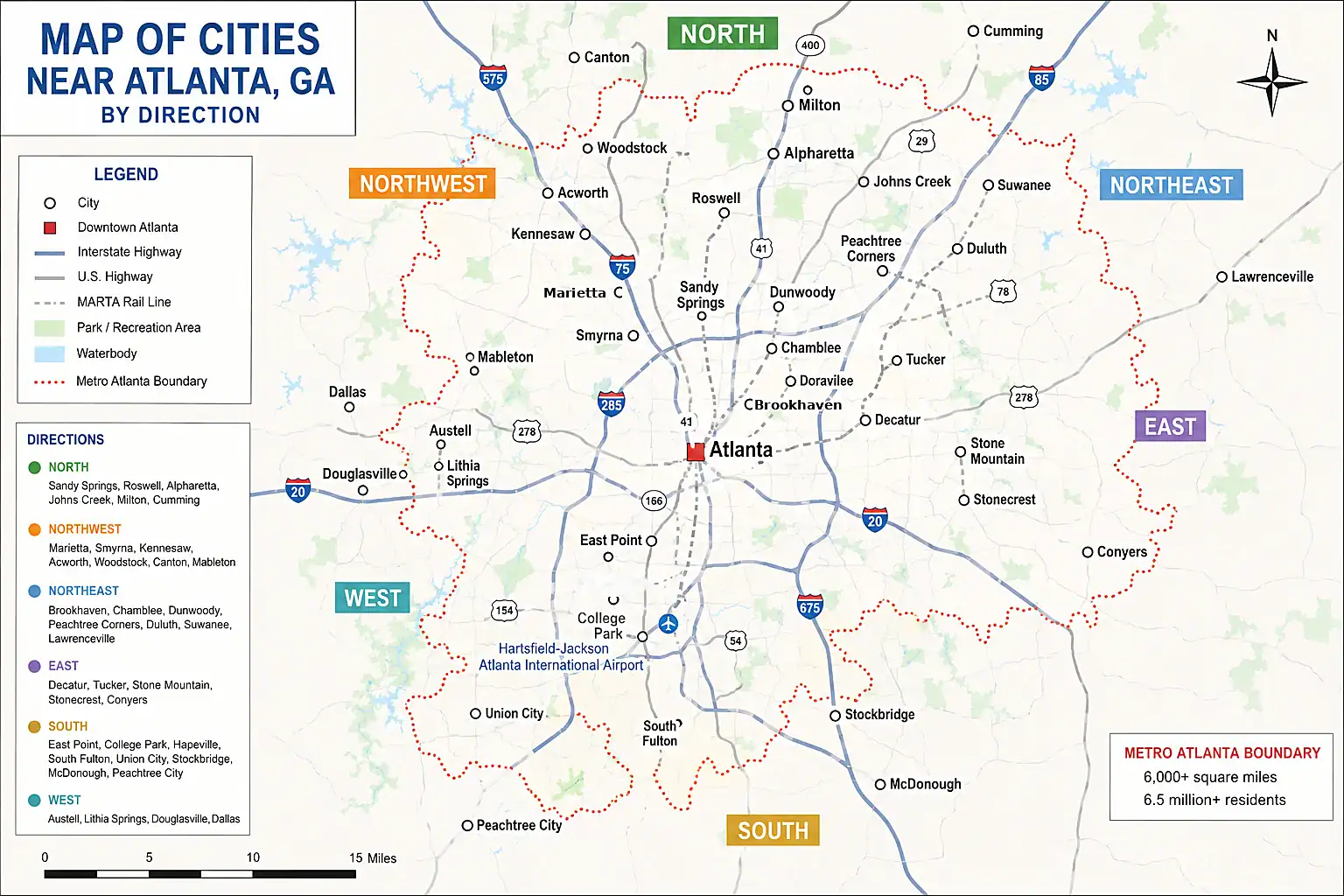
This map of cities near Atlanta, GA shows every suburb from the comparison table, color-coded by direction. Notice the ring highway — I-285, “the Perimeter” — because it’s the single most important thing on the map for understanding how locals talk about the metro. Which brings us to the explanation every newcomer needs:
Understanding Metro Atlanta: ITP vs. OTP (Read This Before Choosing a City)
If you’re moving from out of state, this section will save you weeks of confusion.
ITP means “Inside the Perimeter” — inside the I-285 ring highway that circles the city about 10 miles out. OTP means “Outside the Perimeter.” Locals use these constantly, and they’re shorthand for two genuinely different lifestyles: ITP generally means denser neighborhoods, older housing stock, shorter commutes, more walkability, and MARTA rail access (Decatur, Brookhaven, East Point, Hapeville, Chamblee). OTP generally means newer and larger homes, more land, suburban school districts, and car-dependent living (Marietta, Alpharetta, Woodstock, Lawrenceville, Peachtree City). Neither is better — they’re different products, and knowing which one you want cuts your city shortlist in half immediately.
Why is Marietta “Atlanta”? Because “Atlanta” means three different things depending on context. The City of Atlanta is ~530,000 people, mostly in Fulton County. Metro Atlanta is ~6.5 million people across 29 counties — when someone says they live “in Atlanta,” they usually mean the metro. So Marietta, Alpharetta, and Woodstock are all “Atlanta” in the metro sense while being independent cities with their own governments, taxes, and school arrangements.
The mailing-address trap: huge parts of the metro are unincorporated — not inside any city at all — but carry a nearby city’s mailing address. The most famous example is East Cobb: ~160,000 people with Marietta addresses who don’t live in Marietta, governed directly by Cobb County, with some of the metro’s most sought-after schools. (We wrote a full breakdown of this in our guide to the cities in Cobb County.) Vinings, Candler-McAfee, and much of south Fulton work the same way. Always check whether an address is inside city limits — it affects taxes, services, and sometimes schools.
And the map keeps changing: metro Atlanta redraws itself faster than most people realize. Mableton became a city in 2023 — instantly one of the metro’s largest — and Mulberry in Gwinnett County followed in 2025. If a guide doesn’t mention them, it’s already outdated.
Cities North of Atlanta
The vibe: technology money, marquee schools, and the GA-400 corridor.
This is where relocating tech and healthcare families usually start looking — and where prices reflect it. Sandy Springs sits just outside the Perimeter with the metro’s second downtown at City Springs and the rare suburban luxury of a MARTA rail line. If you’re torn between suburban schools and a downtown you can actually walk to dinner in, Roswell is one of the few places around Atlanta that gives you both. Alpharetta is the corridor’s economic engine — Avalon, the tech campuses, a downtown that became a destination — while Johns Creek trades the nightlife for the metro’s most consistently top-ranked schools, and Milton is where the corridor turns into horse country. One honest warning: this corridor has the metro’s longest Downtown commutes, which is why so many residents work locally or at Perimeter Center instead.
Moving note: north-metro moves are heavy on gated communities and HOAs with move-in windows and elevator/loading-dock rules in the newer townhome districts. Build HOA lead time into your moving date — it’s the #1 avoidable delay we see.
Cities Northwest of Atlanta (Cobb & Cherokee)
The vibe: historic squares, Braves games, lake weekends, and the metro’s best space-for-money.
The I-75 corridor is where families go when they want a real house without surrendering the city. Smyrna is closest in — Truist Park and The Battery are effectively a neighborhood amenity. Mableton is the corridor’s value story: Cobb’s newest and largest city, just 13 miles out, with prices the north side hasn’t seen in a decade. Marietta anchors the county with the metro’s best historic square, and unincorporated East Cobb beside it carries the marquee schools (Walton, Pope, Lassiter). Farther out, Kennesaw hums with college-town energy around KSU, Acworth offers actual lake living on Allatoona, and up I-575, Woodstock has quietly built one of the metro’s best walkable downtowns. We covered this entire corridor city-by-city in our Cities in Cobb County guide.
Cities Northeast of Atlanta (DeKalb & Gwinnett)
The vibe: the metro’s international side — transit, growth, and the best food corridor in the Southeast.
Brookhaven is the closest large city to Atlanta — ten miles, a MARTA station, and Buckhead-adjacent prices to match. Chamblee and Doraville pair rail stations with the Buford Highway food scene, arguably the best international dining corridor in America. Into Gwinnett, Peachtree Corners and Duluth mix office parks with world-class Korean, Chinese, and Indian food; Suwanee collects parks awards; Lawrenceville is the county seat and its value center; and brand-new Mulberry — Georgia’s newest city, incorporated 2025 — is so new most guides don’t know it exists.
Cities East of Atlanta
The vibe: intown character, lighter traffic, and the most affordable close-in living.
Decatur is the crown jewel of intown living — six miles out, its own celebrated school system, a square you’ll actually spend your weekends on, and prices that reflect all of it. Tucker and Stone Mountain village offer established neighborhoods at east-side prices, and Stonecrest has some of the metro’s newest affordable construction next to Arabia Mountain’s hiking. The east side also benefits from MARTA’s east rail line and noticeably lighter traffic than the northern corridors.
Cities South of Atlanta
The vibe: the metro’s best-kept value secret, anchored by the world’s busiest airport.
East Point, College Park, and Hapeville sit 7–9 miles from Downtown with MARTA rail and the metro’s most affordable close-in historic homes — all three are riding serious renovation momentum. South Fulton (incorporated 2017) is one of the largest majority-Black cities in America. Farther out, Peachtree City is nationally famous for its 100+ miles of golf-cart paths and beloved by airline families, while Stockbridge and McDonough along I-75 South offer new construction at prices the north side left behind years ago.
Cities West of Atlanta
The vibe: quiet, green, and the last true bargains inside a 20-mile radius.
Austell still has detached homes under $350K seventeen miles from Downtown — increasingly a unicorn anywhere in this metro. Douglasville anchors Douglas County with a historic downtown and Sweetwater Creek State Park next door, and Paulding County beyond it (Dallas, Hiram) is where many first-time buyers finally land.
How to Choose the Right Atlanta Suburb
Forget memorizing thirty cities. Answer three questions and your shortlist builds itself: Where will you work (Downtown/Midtown, Perimeter, the northern tech corridor, the airport, or remote)? Do you need MARTA rail, or will you drive? And which trade do you want — walkability and character, or square footage and schools? Then match:
- Shortest commute + walkability → Decatur, Brookhaven, Hapeville, East Point
- Top-ranked schools → Johns Creek, East Cobb (unincorporated), Decatur, Milton, Forsyth County
- Best value within 20 miles → Mableton, Austell, East Point, Stone Mountain, Forest Park
- Young professionals → Brookhaven, Smyrna, Chamblee, Decatur
- Luxury & estates → Milton, Alpharetta, Johns Creek, Roswell, Sandy Springs
- Rail commute (MARTA) → Decatur, Brookhaven, Chamblee, Doraville, Dunwoody, Sandy Springs, East Point, College Park
- Small-town downtown, big-metro access → Woodstock, Roswell, Marietta, Acworth, Duluth
- Airport-based work → Hapeville, College Park, East Point, Peachtree City, Stockbridge
A Mover’s Honest Notes on Relocating to Metro Atlanta
A few things we tell every family relocating here, based on what actually goes wrong on move days:
Traffic decides your happiness more than your house does. A 26-mile Alpharetta commute and a 13-mile Mableton commute can take the same hour at 8 AM, in opposite directions. Before you commit to a home, drive your exact commute at your exact hour — both ways. The table’s drive-time ranges are honest, but your specific route matters more than any average.
HOAs and gates run the calendar in the northern suburbs. Many communities in Alpharetta, Johns Creek, Suwanee, and the newer townhome districts restrict move-in days and hours, require certificates of insurance from your mover, or need gate access arranged in advance. Handled early, it’s paperwork; discovered on move day, it’s a rescheduled move.
Intown moves are access puzzles. Historic streets in Decatur, East Point, and College Park mean narrow roads, street-parking permits, and trees that don’t respect box trucks. The right truck size chosen in advance beats the big truck stuck at the corner.
Coming from out of state? Our long-distance moving team handles inbound relocations to every city in this guide, and our instant estimate calculator gives you a realistic price range in under a minute — no callback required.
FAQ: Cities Near Atlanta, GA
What are the closest cities and towns to Atlanta, GA?
The closest incorporated cities to Atlanta are Decatur (about 6 miles from Downtown), Hapeville (7 miles), East Point (8 miles), College Park (9 miles), and Brookhaven (10 miles). The closest town to Atlanta by drive time is typically Decatur or Hapeville, depending on your starting point. Well-known communities like Druid Hills and Vinings are even closer but are unincorporated areas, not cities.
What are the largest cities near Atlanta?
The largest cities in metro Atlanta outside Atlanta itself are Sandy Springs (~110,000), South Fulton (~110,000), Roswell (~93,000), Johns Creek (~82,000), and Mableton (~78,000). Mableton incorporated in 2023, so older lists omit it.
What is ITP and OTP in Atlanta?
ITP means “Inside the Perimeter” and OTP means “Outside the Perimeter” — the Perimeter being I-285, the ring highway around Atlanta. ITP generally means denser, more walkable intown living; OTP generally means larger suburban homes and car-based living. Locals use both terms constantly.
Is Marietta part of Atlanta?
Marietta is an independent city and the county seat of Cobb County, but it is part of metro Atlanta. When people say they live “in Atlanta,” they usually mean the 6.5-million-person metro area, which includes Marietta, Alpharetta, Woodstock, and dozens of other independent cities.
What cities are within 30 minutes of Atlanta?
In typical traffic, cities usually within about 30 minutes of Downtown include Decatur, East Point, Hapeville, College Park, Brookhaven, Chamblee, Smyrna, Mableton, Forest Park, and Doraville. At rush hour, distance matters less than direction — always test your specific route.
What cities are within 1 hour of Atlanta?
Nearly the entire metro is within an hour of Downtown outside of peak traffic, including Marietta, Roswell, Alpharetta, Johns Creek, Woodstock, Lawrenceville, Douglasville, Stockbridge, McDonough, and Peachtree City. At rush hour, the far-north suburbs (Alpharetta, Johns Creek, Milton, Cumming) commonly exceed an hour.
Is Alpharetta part of Atlanta? Is Sandy Springs?
Alpharetta and Sandy Springs are independent cities with their own governments — but both are part of metro Atlanta, and residents commonly say they live “in Atlanta” when talking to anyone outside Georgia. The same goes for Marietta, Roswell, Woodstock, and every other suburb in this guide: separate cities, one metro.
What is the closest major city to Atlanta?
Athens, GA (~72 miles) is the closest sizable Georgia city, followed by Macon (~84 miles). The closest major out-of-state cities are Birmingham, AL (~147 miles), Chattanooga, TN (~118 miles), and Greenville, SC (~145 miles).
What is the newest city in metro Atlanta?
Mulberry, in Gwinnett County, is metro Atlanta’s — and Georgia’s — newest city, incorporated in 2025. Before Mulberry, the newest was Mableton in Cobb County (2023), now the county’s largest city.
Moving to One of These Cities?
Brown Thrasher Movers helps families relocate to and between cities across metro Atlanta and North Georgia — from intown Decatur bungalows to Alpharetta estates to brand-new Mableton townhomes:
- Local residential moving
- Long-distance & interstate moving (relocating to Atlanta from out of state)
- Apartment, condo & townhome moving
- Guide: Cities in Cobb County, GA
- All areas we serve
Sources checked for accuracy: U.S. Census Bureau (metro population 6,482,182, 2025 estimate; city populations are recent Census estimates rounded), Atlanta Regional Commission, MARTA, and Zillow metro Atlanta home values. Home price tiers are mid-2026 approximations; distances are road miles from Downtown Atlanta; drive times are typical weekday rush-hour ranges and vary by route and hour.